
The situation
Moving to Spain starts as an idea and quickly becomes paperwork, taxes, healthcare, housing and a lot of doubt. Hieke Voorberg, Annebeth Vis and Noah started Emigreren kun je leren to give Dutch speakers honest information and practical training, based on what they went through themselves.
The platform had grown on WordPress with a course plugin, a shop plugin and a pile of page-builder templates. It held three paid courses, a directory of partner services, a long list of articles and a newsletter, and every change took longer than it should. Publishing a post with proper search settings was work for a specialist, and the customer accounts were tied to the old system.
The website
Everything moved across. More than a hundred articles, the partner services, the pages, the three courses and the customer accounts. Existing customers sign in with a code sent to their email and find their courses and progress where they left them.
Homepage and services kept their shape. The brand stays: brown, orange, cream. The homepage and the services overview keep the layout visitors know. Articles, lessons and accounts got a quieter reading layout, with real people and places instead of stock images.
Courses the team can build themselves. A course is a route with stages and lessons. The team adds lessons and puts them in order by dragging. Paid lesson content stays hidden until someone has bought access.
Customers get their own place. Courses with progress, orders, and their details. A customer can also ask for their data to be removed from there.
Buying on the site. Checkout runs on the site itself, with the usual payment methods for the Netherlands. The course page says what is in the course before it asks for anything.
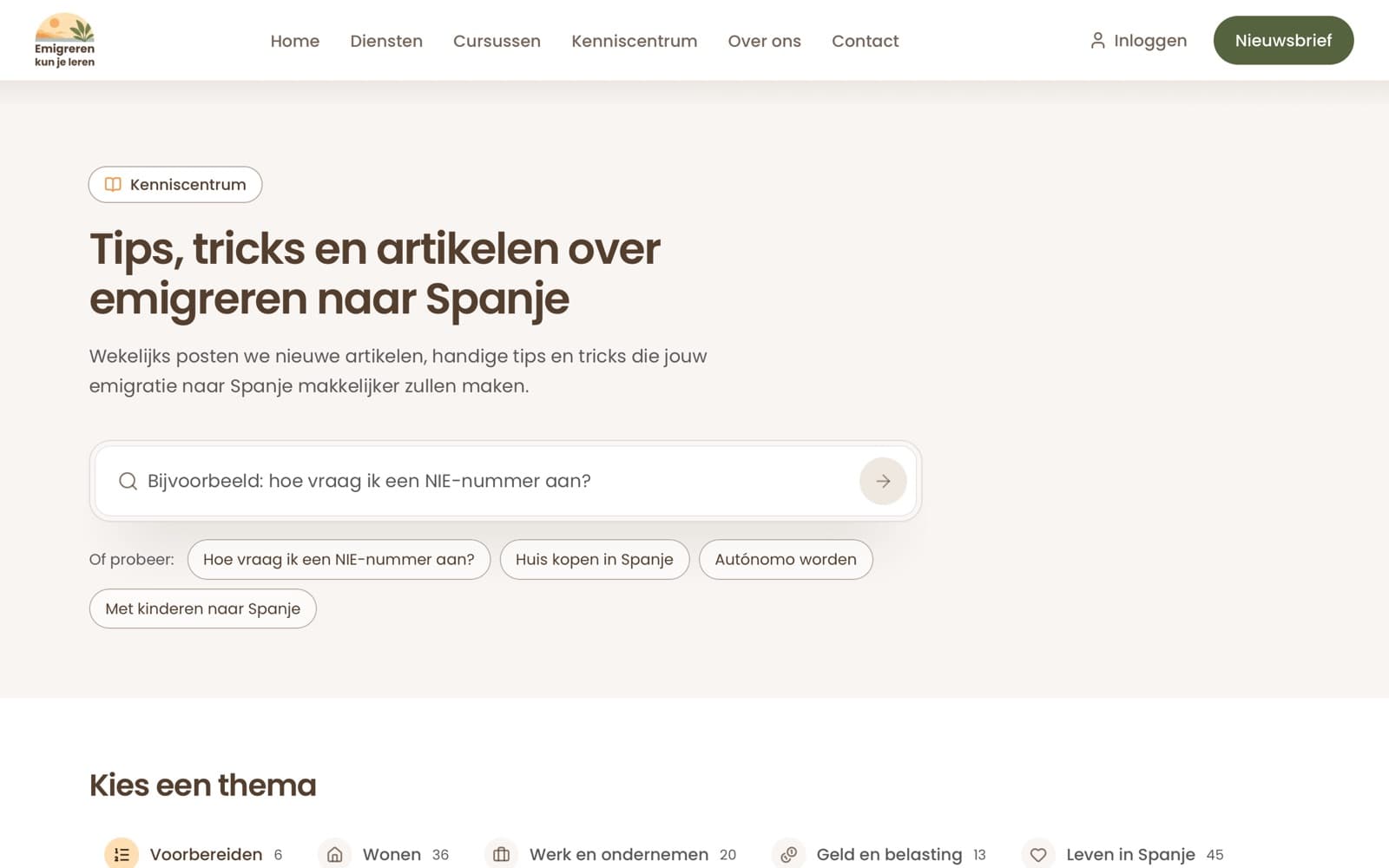
The knowledge centre
Over a hundred articles are only useful if someone can find the right one.
Search that feels like asking. A visitor types a question, such as how to apply for an NIE number, and gets the matching articles. It runs in the browser from a list of the articles, so it is quick and nothing a visitor types is sent anywhere.
Topics in themes. The articles sit in nineteen topics, grouped in five themes: preparing, housing, work and business, money and tax, and living in Spain. Visitors browse by theme when they don't yet know what to ask.
An offer under each article. Where a course or a partner service fits the article, a short offer follows it, chosen per topic.
Services and partners
The directory lists eighteen services in four groups: housing, work, administration and living. Each service has its own page and a short request form.
Requests land in the team's own system. A request from a service page goes straight into the team's hub, so nobody copies it from an inbox. If the connection is down, the team gets it by email instead.
Publishing, made easier
The team wanted to publish and optimise articles without calling us.
Suggestions in the editor. Under an article, a panel suggests a page title, a description, descriptions for the images and links to other pages on the site and to outside sources. Links that no longer work are left out. The editor accepts what helps and ignores the rest, and nothing is applied on its own.
Paste an address, it still works. The team pasted a full web address into the address field of a new post. The field now accepts that and turns it into the right form.
Reviews with checks. Visitors can leave a review through their account. Every review is checked before it shows, and visitors can report one.
Getting found
Old addresses still work. The new site was checked against the 159 addresses on the old sitemap, and pages that were renamed send visitors and Google to the new place.
Sitemaps and structured data. The sitemap lists the pages, and the articles, services and courses describe themselves to Google in a form it can read.
Links between articles. Articles end with links to related pages, and we sharpened those after launch so a reader always has a next step.
What changed for them
The three founders can publish and edit on their own. Customers keep their accounts and progress. Visitors can search the knowledge centre as they would ask a friend, and an article leads on to the course or partner that fits it.
What we keep doing
The site is looked after on a fixed monthly fee: hosting, monitoring, backups and updates. New features come out of what the team asks for, and the search side gets a regular check. When the team wants something new, such as a new course or a change to the offer, we build it on the same site.
 Visit the siteemigrerenkunjeleren.com